Branding4 Apr 2024
The 8 essential brand assets that humanise your brand


A logo from one designer, then colours picked to suit a website, plus add on photography chosen on the morning of a shoot. An identity assembled one project at a time looks and sounds different everywhere a customer meets it, and that quietly costs both recognition and trust. Belong Creative works the other way around, defining the full set together based on a unifying value proposition - so each element works together to build trust.

In short
Brand assets are the recognisable elements that make up your identity: logo, colour, type, imagery, voice and more. The right set, used consistently, builds a visual identity that feels human and helps people recognise and trust your business.
Key takeaways
- Start with the value proposition. It decides what the visual work is expressing, so settling it first avoids reworking colours, type and imagery later.
- The full set is covered in this article: logo, value proposition, tagline and brand promise, brand personality, colour palette, typography, imagery and brand style guide.
- Colour can carry protected equity:. Tiffany's Blue and Cadbury's Purple are registered trademarks, so no one else can use them in their categories.
- A tagline can move commercial results. Avis grew market share from 29% to 36% behind 'We Try Harder', and Domino's built its 30 minute delivery guarantee into becoming the largest pizza brand in the world.
- For mid-sized businesses and larger, where several teams and suppliers touch the brand, the style guide is what keeps the whole set working as one.
What are brand assets?
Have you ever been judged just on looks? How did you feel? Unfairly treated. Disrespected? Unknown for who you really are? Well what if you were a brand – should I just take you at face value? Or get to know you better and see if your values align with mine?
In much the same way as you get to know a person (what they value and believe in, what they sound like, what their unique strengths and character traits are), a well-considered brand has these layers too. We call these layers ‘brand assets’.
The most iconic brand asset is your logo. But like a person, a brand is much more than just the ‘face’ of the business, product or service featured on the shop window or on top of the website. You see when brands take on more human qualities it makes them more relatable. People are drawn to brands and brands are drawn to people in the same way as human relationships. In both cases we seek a meaningful value exchange – i.e. should I make a connection and is there a win/win for both parties? So in this sense, brand assets are a useful tool to help consumers to decide whether to engage and invest, or not!
So what are the different types of brand assets, why are brand assets important and how do brand assets relate to each other? There are 8 key brand assets that support a brand to be more human. Let’s take a look at each one in more detail.
What are the 8 essential brand assets?
1. Logo - ‘Your Face’
Ok, yes, the most obvious brand asset is the logo. In fact, many people see the logo AS the brand. But that’s like saying the Queen IS the monarchy, forgetting about everything else that creates people’s ‘royal’ perceptions. Take away the crown, throne, castles, clothes, lineage (even scandals!) and there is simply a woman who is representing everything else that the monarchy (aka brand) stands for. While a logo is a memorable visual symbol, it is only part of the toolkit to creating a deeper and wider impression on your target audience. A successful logo embodies the following principles:
• Be easy to read and understood
• One or two colours
• Sums up your identity in a meaningful way
• Balance familiarity with novelty
• Have an element that is unique making it iconic

Successful logos including McDonalds, Coca-Cola, Nike and Apple have a simple iconic quality recognised around the world. Think about how much comes to mind when you look at each one – that’s the power of branding beyond just the symbol you see.
2. Value Proposition – ‘Your Heart’
What does your brand deliver that your target audience wants or needs? This is your value proposition. With the help of discovery tools, like customer research, you will be able to articulate what makes your business, service or product special and describe the benefits that resonate with your ideal customer, employee or investor. A value proposition is built around 3 strategic pillars – Authenticity, Relevancy and Differentiation. Once defined, your Customer Value Proposition (CVP), Employee Value Proposition (EVP) or Investor Value Proposition (IVP) encapsulates WHY someone would want to belong to your brand and therefore becomes the inspiration for all your other brand assets. This is the very heart of your brand and should be developed BEFORE you work on any other brand assets.
• Authenticity – what you promise and can truly deliver on
• Relevancy – what you offer that resonates with your target audience while at the same time supporting your business strategy
• Differentiation – what sets you apart from competitors giving you a ‘clear space to own’ in your target audience’s mind
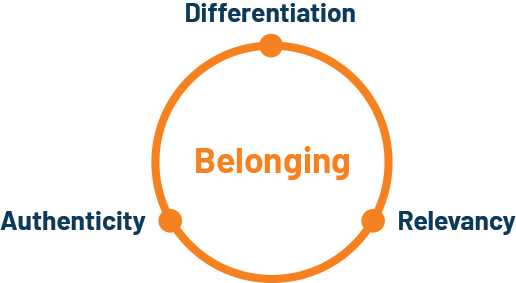
Brands build around a strategic framework are more likely to elicit a stronger sense of belonging, loyalty and advocacy amongst customers.
3. Tagline & Brand Promise – ‘Your Expertise’
While a logo and business name can tell you a lot, a tagline and/or brand promise (a few words or succinct statement) that positions your brand for success can be a very powerful asset. You can use a tagline to separate you from competitors and outline your unique point of difference. This can also be your promise to customers. This is your big strategic play. A great tagline can help propel business growth and dominate market-share. One of the most renowned examples is when Avis back in the 60s developed one of the first ever underdog campaigns as the No.2 challenger brand and introduced their brand promise - We Try Harder, growing their market share from 29% to 36%.(1) More recently Domino's rebrand in 2013 underpinned with the brand promise guarantee of ‘Pizza delivered in 30 minutes or its FREE!’ has seen it totally dominate the pizza sector and is now the largest pizza brand in the world.(2)
When developing a tagline or brand promise consider the following:
• Make them punchy, memorable and meaningful
• Sum up your value proposition with a ‘what’s in it for me’ view as the customer
• Based on ‘Why choose me?’, not ‘What we do’ (as this does not differentiate you from others)
• As your brand evolves your tagline or promise can go from more literal (i.e. how we do things) to conceptual (i.e. an attitude, belief or feeling)
• If it is a tagline keep it locked up with your logo to reinforce it’s a consistent brand position, not a trending headline

Taglines and Brand Promises stick in our minds and create positive brand associations every time we see and think about a brand.
4. Brand Personality – ‘Your Personality’
How does your brand behave? When you write web copy, post on social, design an advert, answer the phone, make a presentation - what is your brand’s tone of voice? A brand, just like a person, feels more alive when it has a distinctive personality. What personality do you want to convey to your target audience? Are you conversational, fun, professional, reliable, quirky, personal, caring or a hybrid. By strategically choosing the right personality for your brand and articulating it as a brand asset can be one of your most distinctive tools in standing out in a competitive marketplace! Here’s a few tips:
• If you’re rebranding, do a Brand Personality Workshop to understand the gap between your perceived personality now and what you aspire for it to be
• Think about your customer avatars – what sort of personality would resonate with them?
• Leverage your personality to choose your colours, typography, imagery style and define your tone of voice.
5. Colour Palette – ‘Your Dress Sense’
There is a psychology to colour that is built into all of us. Warm colours create a sense of energy and movement - they are attention grabbing. Blue has a dependable sense of trust. Green speaks to nature. Black to premium or elitist. Purple to mystery and royalty. Sometimes colours have cultural significance and differ in meaning in different parts of the world. So being cognisant of that is important. Some helpful tips when developing your colour palette are:
• Be inspired by your value proposition and brand personality
• Ensure your colours are NOT the same as your competitors
• More successful brands have only 1-2 main colours associated with the brand – any more and it is less memorable.
• Consider how your colours look in both digital and print channels
• Create a secondary palette to help give you flexibility for multi-coloured or tinted charts and diagrams

Two of the world’s best examples of brand colour association would be Tiffany’s Blue and Cadbury’s Purple. These colours are such a powerful asset they are registered trademarks meaning no-one else can use them in their categories. Interestingly both these brands use colour as an essential ingredient to their packaging.
6. Typography – ‘Your Walk ‘n’ Talk’
Often underrated as a powerful brand asset, your typography (font choices) can give your messaging a distinctive character that is as unique as you. A serif font can create a sense of heritage and prestige. Rounded is more friendly, while square is more technical. Leaning forward gives a sense of energy and speed. Handwritten portrays an authentic, real and raw voice. Things to look for when developing typography for your brand include:
• Choose a font that has multiple weights (i.e. thin, regular and bold) as it will give you more variety in your design
• A Google Font is often a good choice as it is open source meaning it is free and easily accessible for websites. Pick a font that is readable online and in print
• Be inspired by your brand personality
• Add a Microsoft font for your internal teams to use in Word and Powerpoint
7. Imagery – ‘Your Insta Feed’
They say a picture is worth a 1000 words. But what if you could apply a cohesive approach to ALL your imagery so together they help convey a much stronger sense of your brand. There are plenty of easy ways to source imagery for your advertising and marketing efforts – but what’s not as easy is to stand out and not look like all your competitors. This is where injecting plenty of your brand personality can make a big difference. Check out these ideas…
• Transform stock imagery into a branded collection by choosing imagery that matches your colour palette or add a unique element that only you can own
• Create your own bespoke imagery – hire an illustrator, commission an artist or photographer
• Icons are a simple visual asset that can add personality – they can be literal, conceptual or sketchy to match your brand personality - making sure they have a family feel in style

For Carrera we developed a cohesive set of imagery and icons inspired by the brand promise of ‘Master Every Turn’. We created an ‘ownable’ series of images that used black and white people photography that integrated world-city-road maps ‘tattooed’ onto their faces. Iconography also followed the ‘every turn’ theme.
How do the 8 brand assets work together?
8. Brand Style Guide – ‘Your Auto-Biography’
A brand style guide is an essential tool that documents all your brand assets in one centralised place.
It allows anyone assigned with delivering branded collateral to create a cohesive experience for your target audience. Managers and suppliers that create your advertising or graphic material such as social media managers, videographers, photographers, sign makers, PR agents and graphic or digital designers love a clear and comprehensive brand style guide. A successful brand style guide can take different formats such as:
• Interactive PDF – easy to create, it also allows users to navigate around the document jumping to relevant sections quickly. It can be viewed digitally or printed. Any updates to the document must be circulated amongst all stakeholders.
• Web-based – include all your assets in one central, online location. This can be gated for tracking and confidential access, provide search functionality and is easy to update in real time without reissuing a PDF. Also if you have a large database of assets such as print or design collateral templates, imagery or video content, an online portal is a great solution.
Here are a few excellent examples:
Spotify
Starbucks
So now you know the 8 essential assets that make up a brand, it begs the question - how human is your brand?
- Sources:
1. Avis – We Try Harder
2. Dominoes Market Share
Frequently asked questions
How many brand assets does a business actually need?
The eight covered here are the working set: logo, value proposition, tagline and brand promise, brand personality, colour palette, typography, imagery and a brand style guide. With fewer than that, something is left to chance, and the gap usually shows up as inconsistency, not as an obviously missing piece.
What is the difference between a brand asset and a logo?
A logo is one asset, and on its own it only supports recognition. The other seven carry the meaning: what you offer, how you sound, how you look, and how all of it stays consistent. People judge a business the way they judge a person, on more than a face.
Which brand asset should be developed first?
The value proposition. It sets out why someone would want to belong to your brand, and every visual decision that follows is an expression of it. Choosing colours and typography first means guessing at what you are expressing.
Can a colour be owned by a brand?
Sometimes. Tiffany's Blue and Cadbury's Purple are registered trademarks, which stops anyone else using them in their categories. Most businesses will never need that level of protection, but it shows how much commercial value builds up in one colour used consistently over years.
Explore our brand design, why brand design matters and brand personality.

Other Insights

What is Art Direction you ask? Here’s an analogy that will explain the role which Art Direction plays in the realm of advertising and communications (plus it will probably make you hungry at the same time).

